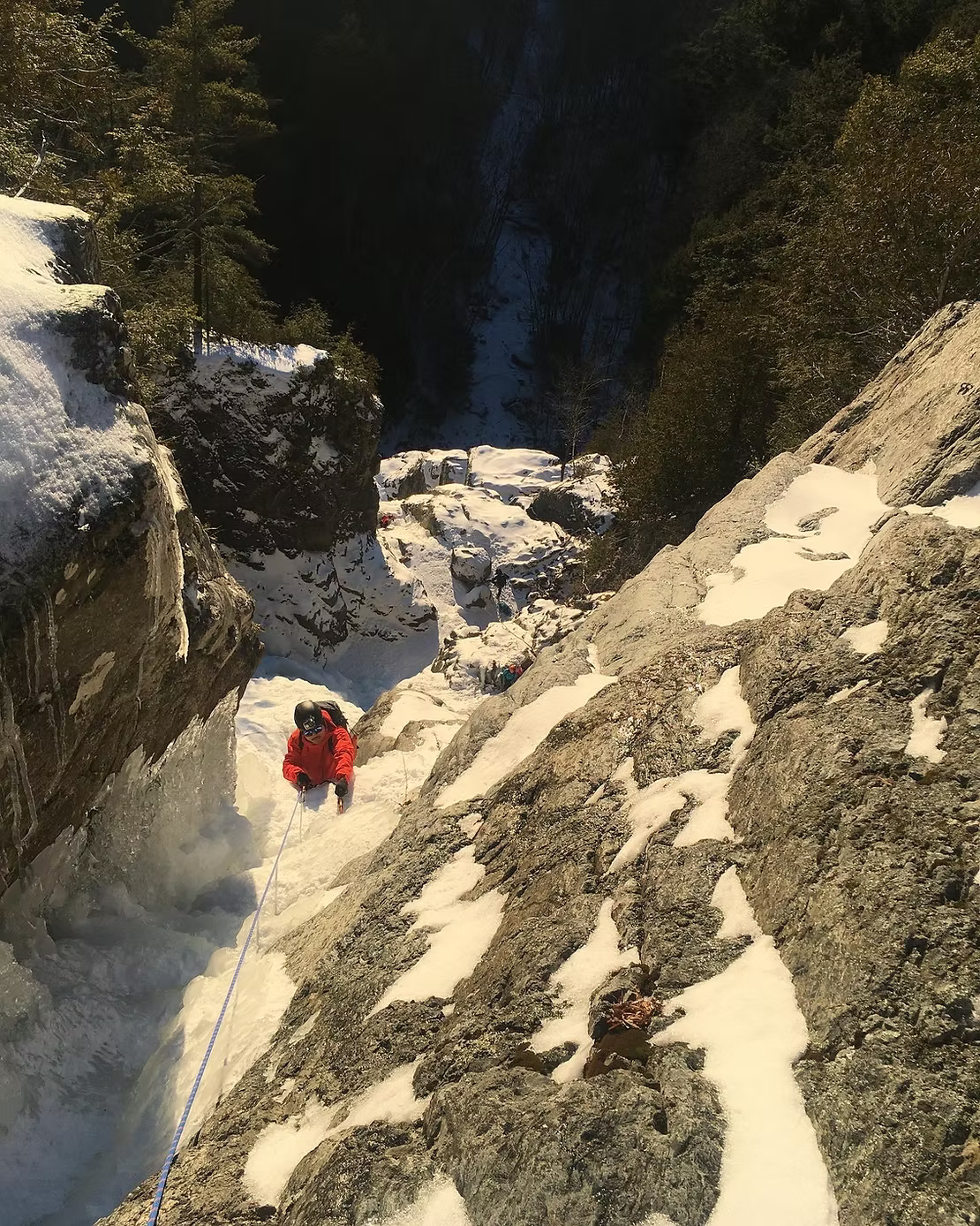
After an incredible fall in the northeast full of warm and sunny days, the weather is becoming cool and damp, laying the groundwork, or waterwork really, for another season of ice climbing and winter adventures here in the Adirondacks.
Unless you're lucky enough to live someplace with close proximity to consistent ice, your climbing season in the winter will likely be relegated to weekend trips or a couple of longer forays. Therefore, I thought it would be beneficial to outline my approach to the start of another winter and maybe short-circuit the process. If some of this is helpful, let me know. If you have your own thoughts to share, let me know that too.
I will break these tactics down into those related to gear, mental approach, and physical fitness. Let's start with gear, since it's the low-hanging fruit, involves the least effort, and fiddling with our gear is something we want to do anyway.
Gear Considerations
For better or worse, ice climbing is a gear-intensive sport. We are dependent upon our equipment to connect us to the medium physically, and the environment is actively conspiring against us, making us at best mildly uncomfortable and at worst potentially hypothermic or susceptible to frost injuries. All that to say, the better the condition of our kit, the better our chances of having a safe and enjoyable day out.
Take all your clothing and gloves out a week or two before your anticipated first day. Do any jackets or pants need a patch from an errant crampon strike? How about retreating the leather palms on your lead gloves or refreshing the DWR treatment on your softshells?
For your sharps, consider leaving ice picks and crampons dull for your first few days and certainly don't put on brand new points, unless you are going someplace guaranteed to have thick ice. Often, the first few days out will involve some unanticipated contact with substances harder than ice. Ruining your brand new picks will not improve the stoke.
On the morning of your first day out, allow an extra 15-20 minutes in your routine for getting dressed and packing. After over a decade of guiding rock and ice climbing year round, this still gets me from time to time.
Mental Approach
Ice climbing is dangerous. Hopefully, we are in agreement on that. Being in possession of a resilient and settled internal state that is capable of managing innumerable, potentially harmful, external factors while being in a dynamic environment is integral to keeping ourselves and partners as safe as possible.
Consider solely top-roping the first day or two out, even if you have lots of experience leading ice. This provides a safer way to re-familiarize yourself with the movement of climbing ice and the nuance of reading ice. Remember that often the top-outs of routes can be undercut or dead end in unfrozen dirt or rock, a horrifying situation if you're leading but not a problem at all if you're on a top-rope.
Forget about grades and focus on conditions. Unlike rock climbing, where it can be very appropriate to say "I'm going to try a 5.9 today," in ice climbing it really is all about conditions. Picking the best route for a given day can be tricky, but when you get it right it is immensely satisfying.
Physical Fitness
Being out in the cold, clearing snow and ice while wearing boots and crampons, and swinging ice tools repeatedly are all physically demanding. If you jump right into it after a few weeks of inactivity, you're setting yourself up for a marginal experience. By doing some prep work starting a month or two before the first day out, your body will be in much better shape for whatever the conditions are.
A strong core is essential for all human movement. Focus on having a mix of exercises, including some that you do not like to do. Chances are, if you do not like it, that's because it exposes a weakness. Address that weakness through consistent, repetitive effort.
Lower body and balance exercises are also important. Think about the big muscle groups involved with swinging your leg repeatedly or boot-packing up an interminable snow slope to get to the route, as well as all the smaller calf muscles working to help you frontpoint.
The upper body is going to be used. Tool hangs, drytooling, and tricep extensions are all fair game. Just remember to also work the antagonistic muscles to combat imbalance and seek out exercises that expose different weaknesses or areas of improvement.
Hope that helps some with the stoke and preparation for the coming season. Let us know if you need help making a day happen!